
- October 2, 2026
- Posted by: admin
- Category: Blog
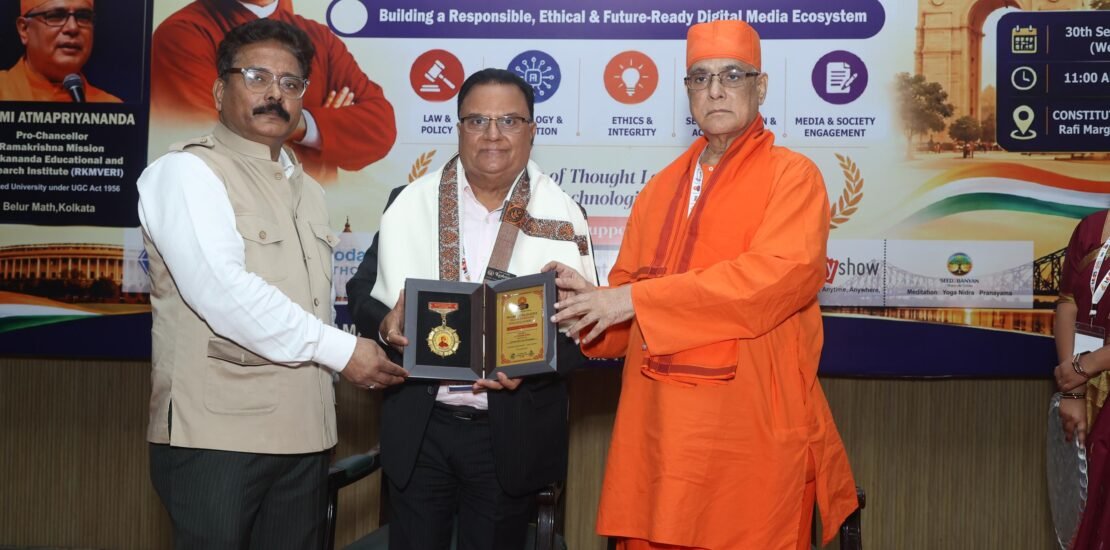
Ramakrishna Parmahansa Foundation | Constitution Club of India, New Delhi | 30 September 2026
The Ramakrishna Parmahansa Foundation (RPF) successfully organised the Swami Vivekananda Digital Journalism Conclave & National Excellence Awards 2026 at the Constitution Club of India, New Delhi, on 30 September 2026, bringing together distinguished voices from spirituality, diplomacy, public administration, journalism, law, technology, public policy and civil society.
Centred on the theme “Building a Responsible, Ethical & Future-Ready Digital Media Ecosystem through Law, Technology, Innovation & Self-Regulation,” the national conclave explored a fundamental question confronting contemporary society: as Artificial Intelligence and digital technologies transform the way humanity communicates, how can truth, ethics, responsibility and human values remain at the heart of journalism?
The deliberations were inspired by the ideals of Sri Ramakrishna Paramahansa and Swami Vivekananda — ideals that place truth, knowledge, character, service and fearless inquiry at the centre of human development.
Swami Atmapriyananda Ji Maharaj: Where Science, Spirituality and the Future Meet
A defining moment of the Conclave was the presence and address of Revered Swami Atmapriyananda Ji Maharaj, Pro-Chancellor of Ramakrishna Mission Vivekananda Educational and Research Institute (RKMVERI).
Swami Atmapriyananda Ji brings to contemporary spiritual discourse the unusual combination of a monk, teacher and scientist. With a PhD in Theoretical Physics and decades of association with higher education, his intellectual journey represents a meeting of scientific inquiry and Vedantic thought.
During his address at the Constitution Club of India, Swami Ji reflected on the rapidly evolving landscape of human knowledge and communication, touching upon areas including Big Data, Artificial Intelligence and the emerging possibilities of Quantum Science.
His reflections brought a larger philosophical dimension to a conclave otherwise centred on journalism and technology.
As Artificial Intelligence increasingly influences how information is generated, distributed and understood, technological capability alone cannot answer every question confronting humanity. The future will also demand discernment, character, responsibility and a deeper understanding of the human being.
The address offered an opportunity to reflect upon something that the Ramakrishna-Vivekananda tradition has long represented: knowledge and spirituality need not exist in separate worlds.
The spirituality of the future cannot remain disconnected from the knowledge of the future.
The vision inspired by Sri Ramakrishna Paramahansa, Holy Mother Sri Sarada Devi and Swami Vivekananda was never confined merely to ritual. It emphasised the harmonious development of the human personality — head, heart and hand; knowledge, devotion and service.
In an era of Artificial Intelligence, Big Data and quantum technologies, that philosophy acquires renewed contemporary relevance.
Science need not become religion, nor religion become science. Both, however, can encourage humanity to question, investigate and search more deeply for Truth.
The enduring appeal of the Ramakrishna-Vivekananda tradition across communities can perhaps be understood through this freedom of inquiry.
It is not about conversion or identity.
It is about the freedom to seek Truth.
More than a century after Swami Vivekananda spoke about the development of human potential, humanity is entering an age in which machines may increasingly augment knowledge and intelligence.
The deeper question is whether technological advancement can be accompanied by an equally profound advancement of human consciousness, character and responsibility.
Perhaps the future need not be a conflict between Science and Spirituality.
Perhaps the human being can become the meeting ground of both.
Akhilesh Mishra: Diplomacy, Culture and Responsible Communication
The Conclave also featured the keynote address of Shri Akhilesh Mishra, IFS (Retd.), former Ambassador and former Director General of the Indian Council for Cultural Relations (ICCR).
Drawing upon his extensive experience in diplomacy and international cultural engagement, Shri Mishra brought a wider global perspective to the discussion on communication and public discourse.
His address placed journalism and communication within the larger context of India’s engagement with the world — highlighting the significance of civilisational values, culture, credibility and responsible communication in shaping how a nation and its people are understood.
In an interconnected digital environment, communication increasingly travels beyond geographical borders within seconds. Journalism therefore carries responsibilities extending beyond merely reporting events. Accuracy, context, cultural understanding and credibility become essential to meaningful public discourse.
His participation underlined the important relationship between diplomacy, culture, communication and India’s engagement with the international community.
K.P. Venkateshwara Rao, IPS: Digital Media, Responsibility and the Challenges of the Information Age
Shri K.P. Venkateshwara Rao, IPS, Additional Director General of Police, Madhya Pradesh Police, brought the perspective of senior public administration and law enforcement to the Conclave.
His address added an important dimension to discussions surrounding the increasingly complex digital information ecosystem.
The extraordinary reach of social media and digital publishing has democratised communication, but it has simultaneously created new challenges involving misinformation, cyber misuse, speed of dissemination and public responsibility.
The discussion highlighted the importance of balancing technological innovation and freedom of communication with accountability, verification and awareness of the consequences that irresponsible digital communication can create.
For journalists and digital publishers, the changing information environment makes accuracy, verification, ethical conduct and an understanding of applicable laws and processes increasingly important.
His participation helped connect the future of digital journalism with the practical realities faced by institutions responsible for maintaining public order and responding to emerging digital challenges.
Vijay Singh Bainsla: Grassroots India, Social Leadership and the Power of Communication
The Conclave was also addressed by Shri Vijay Singh Bainsla, President, Gurjar Aarakshan Sangharsh Samiti, who brought the perspective of grassroots leadership and social engagement to the national platform.
His participation broadened the conversation beyond institutions and technology to the relationship between communication and ordinary citizens.
India’s digital transformation has given communities unprecedented opportunities to express concerns, participate in public discourse and bring local issues into national conversations.
At the same time, responsible journalism has a vital role in ensuring that voices emerging from India’s towns, villages and communities are represented with context, accuracy and sensitivity.
His intervention reflected the importance of connecting the rapidly expanding digital-media ecosystem with grassroots realities, youth aspirations, education, social development and meaningful citizen participation.
The future of Indian journalism will therefore not be shaped by technology alone. It will also depend upon how effectively digital platforms understand and represent the diversity of India’s communities.
Journalism in the Age of Artificial Intelligence
Across its sessions, the Swami Vivekananda Digital Journalism Conclave 2026 examined the transformation underway in journalism.
Artificial Intelligence, automated content generation, social-media platforms, misinformation, changing audience behaviour and emerging digital business models are fundamentally reshaping news and public communication.
Yet the central message emerging from the Conclave was equally clear:
Technology may transform the tools of journalism, but credibility will continue to depend upon truth, ethics and responsibility.
The challenge before the next generation of journalists and digital-media organisations is therefore not merely to adopt new technology but to use innovation responsibly.
Swami Vivekananda National Excellence Awards 2026
The programme also hosted the Swami Vivekananda National Excellence Awards 2026, recognising distinguished contributions across journalism, communication, public service, law, public policy, professional excellence and other areas of national and social significance.
The Awards were conceived in the spirit of Swami Vivekananda’s emphasis on character, service, excellence and nation-building.
Release of “Sri Sri Ramakrishna Kathamrita — As I Have Understood”
Another important moment during the Conclave was the release of “Sri Sri Ramakrishna Kathamrita — As I Have Understood,” authored by Shri Ashim Kumar Mukherjee.
The publication represents an effort to engage contemporary readers with the spiritual conversations and universal teachings associated with Sri Ramakrishna Paramahansa through the author’s understanding and reflections.
Its release alongside a national dialogue on journalism, science, technology and ethics symbolically connected the Foundation’s spiritual inspiration with its contemporary work in knowledge and public discourse.
Ramakrishna Parmahansa Foundation: Connecting Values with Contemporary Challenges
The Ramakrishna Parmahansa Foundation (RPF) is a Kolkata-based registered charitable trust working in the areas of public policy advocacy, media research and social development.
Inspired by the universal ideals associated with Sri Ramakrishna Paramahansa and Swami Vivekananda, the Foundation seeks to encourage responsible public discourse, independent and ethical journalism, media innovation, research, education and socially meaningful initiatives.
Through the Swami Vivekananda Digital Journalism Conclave & National Excellence Awards 2026, the Foundation sought to create a national platform where spirituality and ethics could engage meaningfully with some of the defining questions of our time — Artificial Intelligence, digital journalism, law, technology, governance and the future of communication.
The gathering at the Constitution Club of India demonstrated that conversations about the future of media cannot remain confined to technology.
They must also be conversations about Truth, character, knowledge, responsibility and service.
That intersection — between timeless values and emerging knowledge — remains central to the vision behind the Swami Vivekananda Digital Journalism Conclave.
Ramakrishna Parmahansa Foundation
Public Policy Advocacy | Media Research | Social Development
Swami Vivekananda Digital Journalism Conclave & National Excellence Awards 2026
30 September 2026 | Constitution Club of India, New Delhi